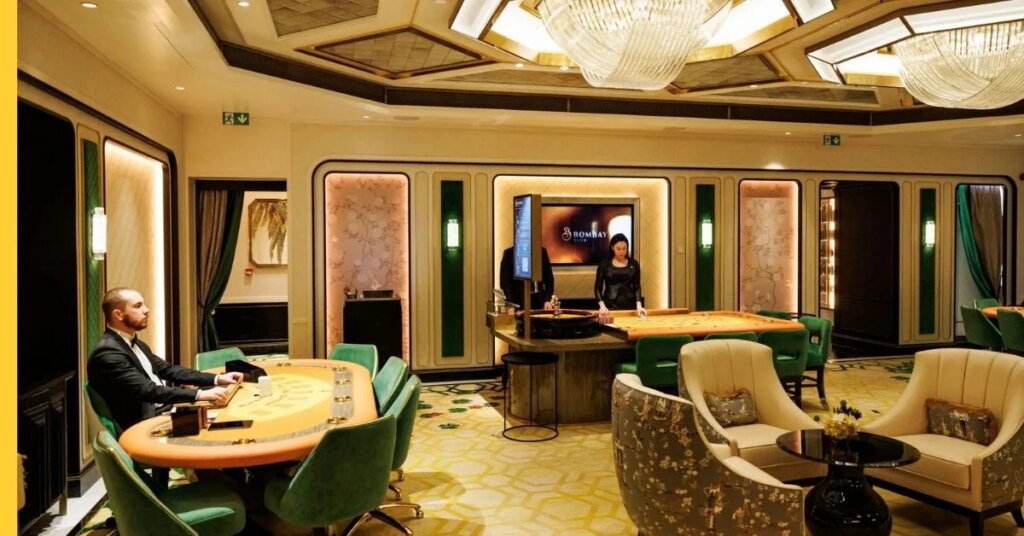
Bombay Group has closed the Bombay Club casino in Tallinn’s Old Town, two years after opening the venue for high rollers.
The lavish casino property marked a major pivot for the group, which shifted from its roots in online gambling towards a high-end land-based casino operation.
The project involved a significant investment and more than five years of renovation work on the 5,000-square-metre site next to Tallinn’s Town Hall Square.
The group’s online brands, Yolo.com and Bombaycasino.com, have also gone offline as Bombay Group scaled back its involvement in B2C gambling operations.
The casino closed today (30 September). Shang Shi, the Michelin-recognised restaurant that formed part of the club’s original concept, will close on 15 November.
The company said Bombay Club employees face redundancy, but has not confirmed how many positions are affected.
Maarja Pärt, a member of Yolo Group’s supervisory board, told NEXT.io that the company is consulting employees as part of the collective redundancy process and assessing each role individually.
Both Bombay Group and its parent company, Yolo Group, already announced significant job cuts as part of a wider restructuring last year.
Customers told to withdraw funds
In a notice to customers, Bombay said they should withdraw any funds held in their Yolo Wallet and transfer the money to their bank account by 30 November 2026.
“This was not an easy decision, and we are truly grateful to everyone who has been part of our journey,” the company said.
The notice describes the move as a pause, however, NEXT.io understands the closure is permanent and a continuation of a “strategic decision taken at group level”.
The group also clarified that the property had been targeted primarily at international visitors to Estonia. “Offering gambling services aimed solely to the Estonian market has never been part of the company’s strategy,” said Pärt.
Yolo Group is instead now focused on providing business services and technology solutions to international gambling companies.
When Bombay Club launched, the group positioned Tallinn as an alternative to established gambling destinations such as London, Las Vegas, Macau and Monte Carlo. Rather than competing on scale, the concept targeted high-net-worth visitors seeking privacy, exclusivity and hospitality alongside gambling.
“Yolo Group has invested a lot of resources into setting up Bombay for success, and we are now expanding the operations to start delivering against our ambitious strategic direction,” Anita Brinke, then CEO of Bombay Group, told NEXT.io at the time.
The club targeted high rollers exclusively, offering them both a gaming experience and opportunities to build connections and relationships.
Bombay Group will continue to operate The Burman, the boutique hotel next to the former casino. Pärt confirmed that the group will adapt the five-storey club building to host private and special events.
The group has also cited Tallinn’s tax environment as a challenge for its restaurant operations. According to the company, the current tax environment is not favourable enough to operate several high-end restaurants in Tallinn’s Old Town profitably on a daily basis.
Yolo Group shifts towards B2B
The closure comes amid a broader restructuring at Yolo Group in 2025.
Bombay Group began cutting roles in late 2025, and by March 2026, more than 250 people had lost their jobs.
In September 2025, Yolo Group announced layoffs in Estonia as it consolidated its B2C operations and shifted towards fully regulated markets.
The group is now placing greater emphasis on providing business services and technology solutions to international gambling companies.
Last year, Yolo Group received gaming-related vendor licences from the United Arab Emirates’ General Commercial Gaming Regulatory Authority (GCGRA) for its subsidiaries Hub88 Holdings and Live Online Gaming Services, which operates the Live88.io and Onetouch.io brands.