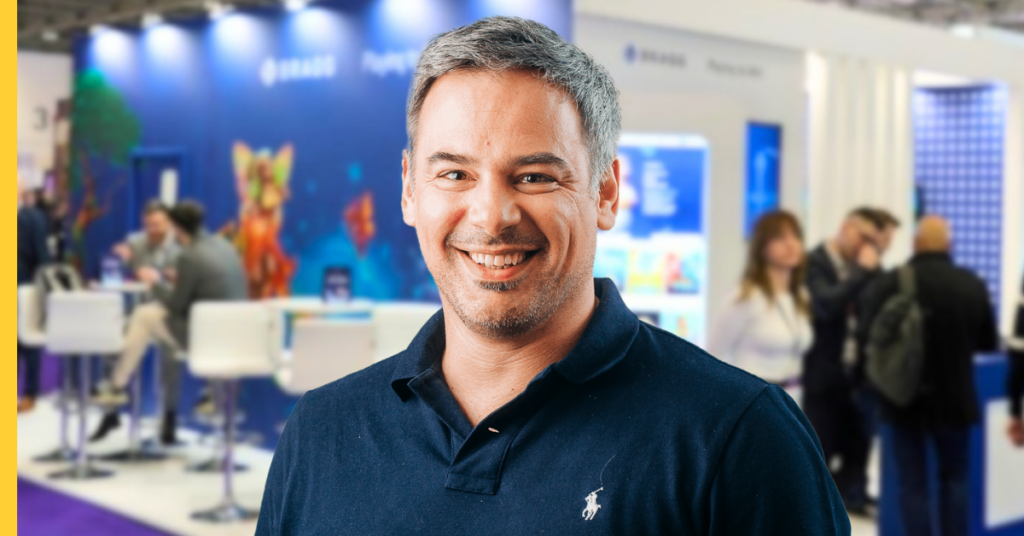
bragg CEO Matevz Mazij said the company is evolving beyond a traditional B2B supplier model and becoming an AI-driven “ecosystem architect”.
Matevž Mazij, CEO of the newly rebranded bragg, has said the company is evolving beyond the traditional B2B supplier model and repositioning itself as an AI-driven “ecosystem architect”.
The business is accelerating its push towards proprietary content following amid a games-first strategic overhaul and proposed acquisition of Drayton International.
Mazij was speaking on the firm’s post-Q1 earnings call yesterday (14 May) on what was a busy day of developments for the company. First came confirmation of its rebrand from Bragg Gaming Group to bragg, shortly followed by news of an agreement worth $9m to acquire Drayton.
The day concluded with publication of bragg’s Q1 results, with these revealing flat revenue and a reduced net loss, with the company maintaining its full-year guidance on the back of the Q1 performance.
Within his post-Q1 notes, Mazij referenced the company’s “games-first” strategy, which was a major talking point in the accompanying earnings call. However, what also become apparent during the call was bragg’s shift from a traditional B2B supplier model to what Mazij billed as an “ecosystem architect”.
“On past calls, I have described bragg’s legacy model as supplying games and technology to the regulated iGaming market,” he said. “But we are evolving from that to focus on a higher-margin, proprietary games-first AI-driven model, stepping into the role of ecosystem architect.”
Bragg refocuses from volume to quality
Going further, Mazij said the change in strategy has been defined by several core shifts “from volume to quality”. He set out how bragg will now move away from low-margin aggregation volume and third-party content dependency towards a proprietary-first IP model and the creation of repeatable game franchises.
Bragg is “changing the core identity from a B2B supplier to the ecosystem architect,” he said. “This means managing the entire player funnel from awareness to intent to retention rather than just providing games with continuing focus on key geographies such as North America, Brazil and core European markets from traditional iGaming to cross-vertical integration.”
Mazij added that the strategy shift was also designed to drive profitability, describing the move as “margin expansion by design”.
“Proprietary content revenue continues to materially outpace overall company growth and carries structurally higher margins,” he said.
He added that moving beyond the “constraints” of regulated iGaming will allow bragg to “aggressively” leverage tailwinds such as prediction markets and advance deposit wagering, with the latter being one of the key reasons behind its proposed acquisition of Drayton.
“Our goal is to use our existing PAM and HUB infrastructure to achieve cross-vertical synergies, integrating racing, lottery and sports betting outcomes into dynamic iGaming experiences,” he said.
Proprietary push reshapes supplier model
Mazij’s comments also offered a clearer indication of how bragg sees the wider supplier market evolving. The company is now increasingly prioritising ownership of content and technology over scale-driven aggregation models.
The shift comes as suppliers across the sector face growing pressure to improve margins, differentiate content and reduce reliance on third-party distribution strategies. For bragg, that appears to mean further investment in proprietary games, AI-led development tools and cross-vertical integration.