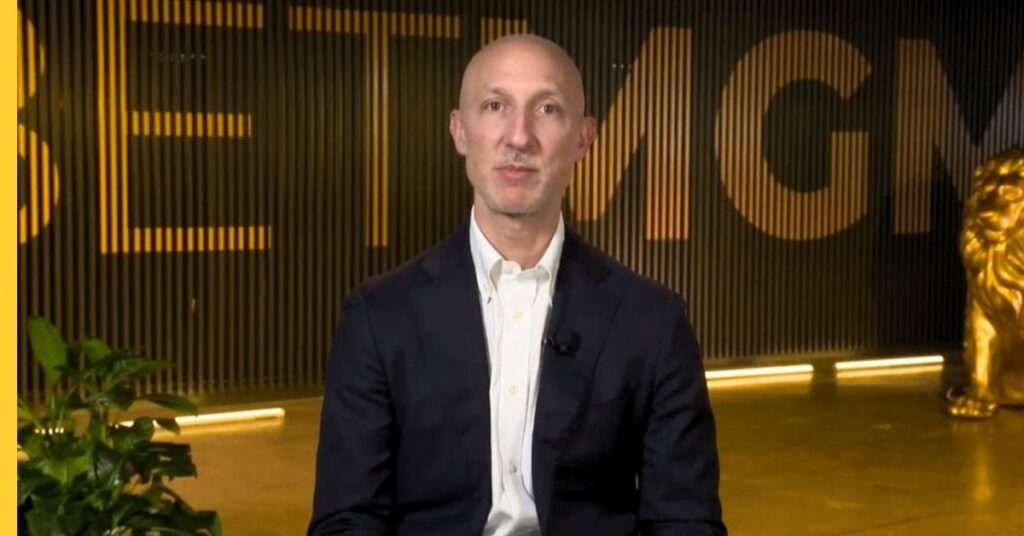
Discussion around prediction markets were highlighted during BetMGM’s first-quarter earnings call, with the operator minimalizing their role.
The discussion around prediction markets took centre stage during BetMGM’s Q1 earnings call, as executives pointed to mounting disruption from new entrants aggressively targeting sports betting customers.
The Q1 call highlighted a clear strategic divide between resilient iGaming performance and mounting pressure in sports betting, in part tied to the rise of prediction markets.
BetMGM confirmed it is operating under the assumption that elevated marketing intensity from prediction market operators will persist through the remainder of the year.
Strategic adjustments in response include reallocating marketing spend toward higher-value segments, and reducing exposure in less efficient acquisition channels.
However, on product dynamics, BetMGM suggested that prediction markets are attracting a distinct subset of users, including highly active or professional-style participants.
The company feels that recreational customers may struggle to sustain engagement in those environments over time, citing faster loss rates and less favourable player economics.
Based on that view, the company expects a portion of users experimenting with prediction platforms to eventually return to traditional sportsbooks.
Prediction markets inflating CPAs
In addition, BetMGM pointed out that prediction market operators are aggressively buying sports betting keywords and media inventory, inflating costs per acquisition (CPAs) and extending payback periods.
Greenblatt said he sees this spending as “irrational” and unsustainable, noting weak unit economics among prediction market players.
As for how that impacts BetMGM’s strategy, Greenblatt was direct: “We’re assuming the current CPA environment prevails for the rest of the year, and our plan for the rest of the year and our guidance for the rest of the year takes that into account.
“So I’m not assuming that what we believe to be irrational current spend suddenly becomes rational. I’m expecting that the land grab that is currently the reality continues, and we are positioning ourselves for when that position changes.”
He further pointed to the strength of BetMGM’s underlying business as evidence of its ability to continue growing.
“[As] an iGaming first operator who’s approaching $2bn of annual iGaming revenue, we are better positioned than most, if not all others, from the ever-escalating noise of prediction markets present in the market,” he said.
Prediction markets could become catalyst for betting legalisation
Besides just competing against each other and against the betting sector, prediction markets are also beginning to impact the larger policy discussion.
As stated by BetMGM, the growing discussion around prediction markets has led to a greater interest in making sports gambling legal in states such as California.
Even amid the increased popularity of prediction markets, BetMGM believes that there will be little cannibalisation, with estimates currently in the low-single digits. Regulated sports betting, meanwhile, continues to see growth on an annual basis.
Greenblatt also explained that BetMGM’s premium customers tend to be incredibly loyal, while lower-level consumers are more willing to move around.
The company expects many recreational users to return over time, however, due to what BetMGM deems its “superior” sportsbook product experience, rewards ecosystem, and regulatory advantages.
Long term, BetMGM views prediction markets as a temporary distortion rather than a structural threat, with expectations that market dynamics will normalise.
Greenblatt added: “We look forward to an expedient outcome of the almost inevitable hearing of the pro-states rights, pro-tribal rights, and anti-prediction markets case by SCOTUS.”
According to its Q1 results, the key business area driving BetMGM’s growth continues to be iGaming. Greenblatt also made it clear that the operator is prioritising quality over quantity, and will therefore likely reduce its user base but increase the profit per user.
While near-term conditions remain volatile, BetMGM expressed confidence that market dynamics will stabilise over time, with expectations that current spending patterns will eventually normalise as competitive pressures ease.