Transnational crime organisations from East and Southeast Asia are rapidly expanding their operations globally as regional enforcement efforts intensify, according to a new report from the United Nations Office on Drugs and Crime (UNODC).
The report, titled “Inflection Point: Global Implications of Scam Centres, Underground Banking and Illicit Online Marketplaces in Southeast Asia,” reveals how criminal networks are strategically relocating to evade law enforcement while maintaining their lucrative enterprises.
The findings confirm recent NEXT.io reporting about the global expansion of Asian crime syndicates, many of whom are engaged in unauthorised gambling targeting the region.
Benedikt Hofmann, UNODC acting regional representative for Southeast Asia and the Pacific, said: “We are seeing a global expansion of East and Southeast Asian organised crime groups.
“This reflects both a natural expansion as the industry grows and seeks new ways and places to do business, but also a hedging strategy against future risks should disruption continue and intensify in the region.”
The investigation highlights how scam compounds previously concentrated in special economic zones across Cambodia, Laos, Myanmar, and the Philippines are now dispersing in response to crackdowns.
Rather than shutting down, operations are simply relocating to purpose-built business parks designed to facilitate online criminal activities.
Hofmann added: “It spreads like a cancer. Authorities treat it in one area, but the roots never disappear; they simply migrate.
“This has resulted in a situation in which the region has essentially become an interconnected ecosystem, driven by sophisticated syndicates freely exploiting vulnerabilities, jeopardizing state sovereignty, and distorting and corrupting policy-making processes and other government systems and institutions.”
UNODC estimates that hundreds of industrial-scale scam centres now generate nearly $40bn in annual profits.
Asian crime syndicates expand globally
These operations have expanded to Africa, South Asia, the Middle East, and Pacific Islands, with related money laundering and human trafficking networks reaching Europe, North America, and South America.
The criminal enterprises have achieved industrial proportions by reinvesting profits and exploiting a vast multilingual workforce consisting of both trafficked victims and willing participants.
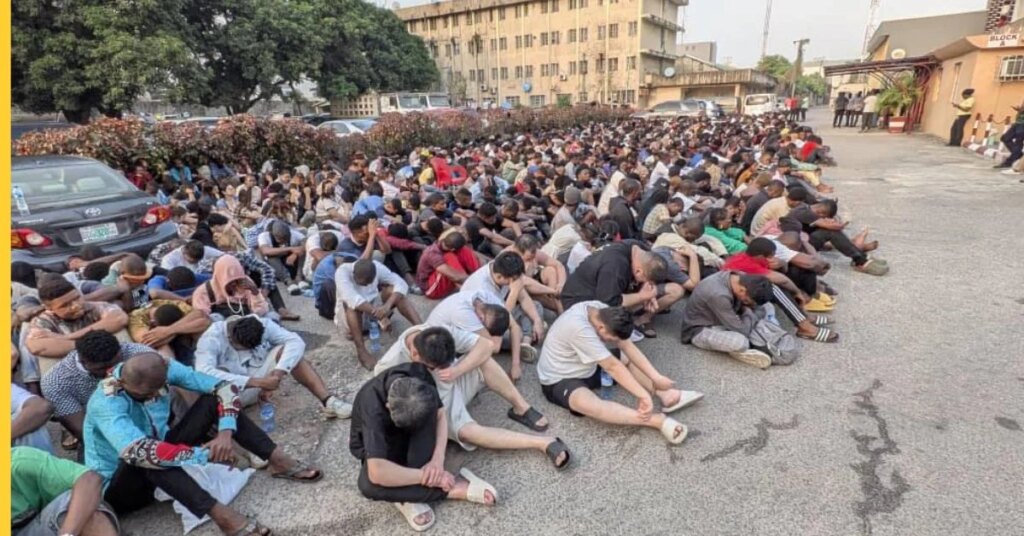
Evidence of this was apparent earlier this year when thousands of people were stranded in Myanmar’s Myawaddy after being released from border-area scam centres.
The report also identifies a troubling trend of increased technological sophistication. Criminal groups are evolving into advanced cyber threat actors supported by money laundering networks, data brokers, and AI-driven technologies that help them adapt to enforcement efforts.
Hofmann explained: “The convergence between the acceleration and professionalisation of these operations on the one hand and their geographical expansion into new parts of the region and beyond on the other translates into a new intensity in the industry — one that governments need to be prepared to respond to.”
The UNODC report offers recommendations for governments to combat these threats, including intensifying financial disruption measures, enhancing coordination on financial intelligence, and scaling up international collaboration on financial investigations and asset recovery.